Foundation Repair in New Braunfels
Foundation repair in New Braunfels for cracked walls, sticking doors, and uneven floors caused by expansive clay soils and the local wet/dry cycle.
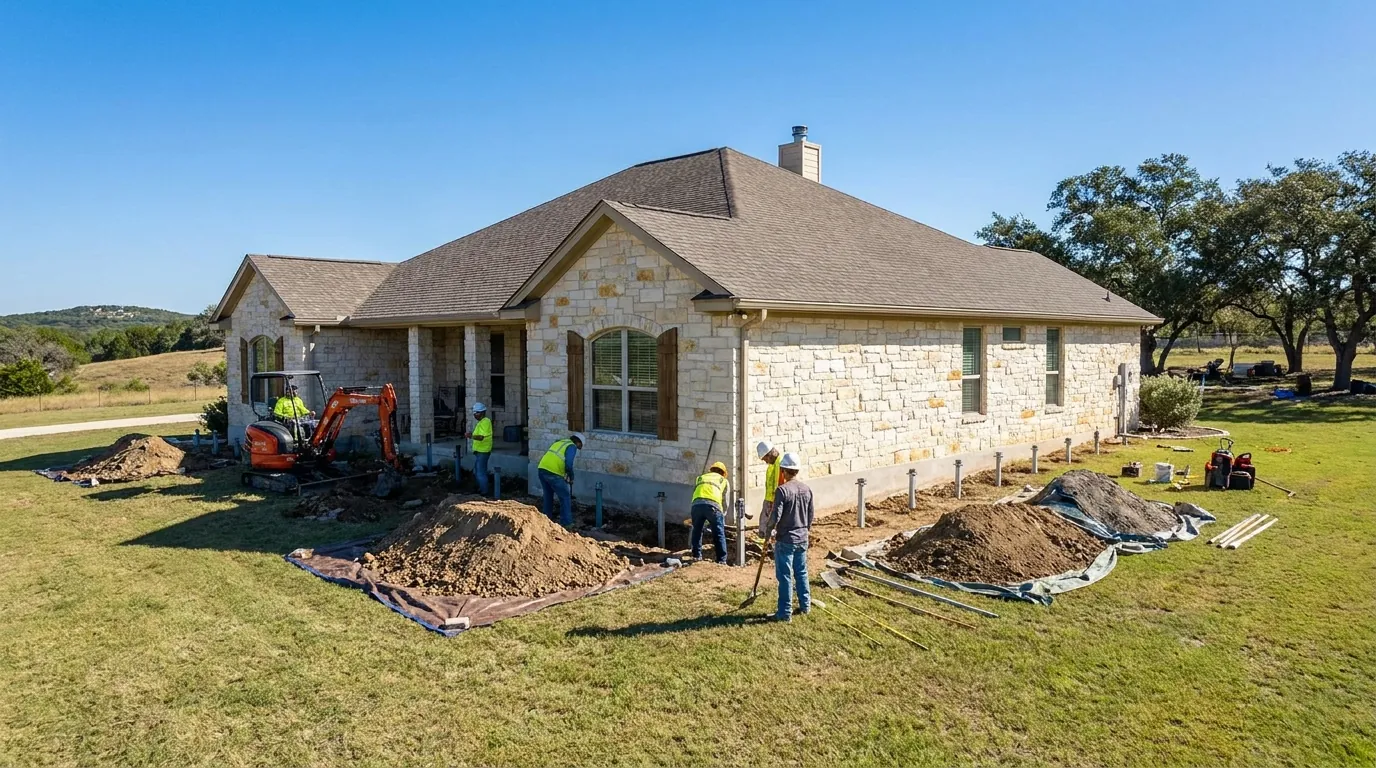
When a Foundation Needs Repair
A foundation in New Braunfels rarely fails overnight. It moves a little at a time as the expansive clay soils beneath it swell after a storm and shrink again through the long, hot summers. Over months and years, that steady push and pull separates brick joints, tilts door frames, and opens cracks that keep coming back after you patch them. If you are trying to repair a foundation before the damage spreads, the first job is understanding what the ground under your house is actually doing.
The warning signs tend to arrive together. Doors and windows that stick or won't latch, diagonal cracks running from the corners of door and window frames, gaps where the crown molding meets the ceiling, and sloping or bouncing floors all point to differential movement — one part of the slab or pier system settling faster than another. Exterior brick showing a stair-step crack along the mortar joints is one of the clearest outdoor signs. None of these problems fix themselves, and the longer clay soil keeps cycling, the wider the gap between the settled and stable areas grows.
The right repair depends on how your home was built. Slab-on-grade houses and older pier and beam leveling homes move for the same underlying reason but call for different fixes. A good starting point for any homeowner is a full foundation inspection that measures elevations across the whole floor before anyone recommends a single pier.
How a Repair Comes Together
Every job is different, but the process of stabilizing a moving foundation follows a consistent path.
-
Measure the movement
We take elevation readings across the floor with a level survey and map where the foundation has dropped or heaved. This shows how much correction each area needs rather than guessing from the cracks alone.
-
Find the cause
Cracks are a symptom. We look at drainage, plumbing leaks, tree roots pulling moisture from the clay, and the soil's moisture pattern around the perimeter to understand why the movement started.
-
Install support
Depending on the structure, that means driving piers to stable bearing below the active clay layer, or shimming and re-supporting beams on a pier-and-beam home to bring the floor back toward level.
-
Lift and stabilize
Supports are adjusted in careful stages to recover elevation without cracking finishes. The goal is a stable, controlled correction rather than forcing everything back to a perfectly flat line at once.
-
Correct the moisture
We address the drainage and watering habits that let the clay swell and shrink, because a repair that ignores soil moisture invites the same movement back.
Local Soil Is the Whole Story
New Braunfels sits on soils that hold a lot of water and give it up just as dramatically. After the sudden storms this area is known for, the clay around a foundation can swell and lift the edge of a slab. Then a stretch of hot, dry weeks pulls that moisture back out, the clay contracts, and the same edge drops. A foundation that never gets a stable moisture environment keeps riding that elevator, and that is why cracks in this region reopen after cosmetic patching.
That is also why we treat drainage correction as part of foundation repair, not a separate afterthought. Keeping water moving away from the house and keeping the perimeter soil at an even moisture level does more to protect a repair than almost anything else. Homeowners in Seguin, Cibolo, and Canyon Lake face the same clay behavior, just over slightly different terrain.
Frequently asked questions
How do I know if my cracks are serious?
Hairline cracks in drywall are common and often cosmetic, but stair-step cracks in exterior brick, cracks that widen over time, and doors that suddenly stick together point to active movement. A level survey measures the actual elevation change so you are not judging by the cracks alone.
What drives the cost of foundation repair?
The main factors are how many support points the structure needs, how deep stable soil sits below the active clay, access around the house, and whether drainage work is included. A home needing a few piers along one corner costs far less than one settling across an entire side.
Can I repair a foundation crack myself?
Sealing a crack hides it but does not stop the movement causing it. If the underlying soil keeps cycling, the crack reopens. It is worth having the movement measured before deciding whether a patch is enough.
How long does a repair take?
Many residential repairs are completed in a few days once work begins, depending on the number of support points and site access. Drainage improvements may add time but protect the result.
Talk to someone about your job
Call to describe the problem and get a quote for work in New Braunfels, TX.